

How to Make Primitive Fire in 6 Ways: The Complete Guide


Camping is great, especially for those who enjoy adventure and challenges. If you're going camping, whether on a beach or in a city with a river and waterfall, you're sure to find a basic setup to comfortably accommodate yourself, such as bathrooms, a stove, and a refrigerator.
However, if you're more adventurous and prefer to venture into nature, the difficulty level increases. Then, you really need to be prepared to face unusual situations, like making fire without matches or a lighter.
Knowing how to make primitive fire is an incredible skill that will certainly make you a much better survivalist! In today's post, therefore, we've brought you unmissable tips to master the art of fire-making! Check them out:
Why should I know how to make primitive fire?
Camping in the wilderness requires more than just courage, as you'll need equipment and experience to deal with any and all situations. After all, your survival can depend on specific knowledge, like making fire primitively.
We've said it many times here on our blog that bringing fire-making tools is essential.
Even so, always keep in mind that when it comes to camping, absolutely anything can happen! You might lose your equipment in a fleeing situation or get it wet when crossing a section of a stream or waterfall – and these are just a few possibilities.
Fire is one of the central elements of survival and the second resource to seek in a critical situation.
Without fire, shelter is unprotected against predators, it's not possible to boil water to hydrate safely or cook food. Smoke can also help ward off mosquitoes and signal your location for possible rescue.
That's why knowing how to make it primitively – that is, without any utensils – is such an important skill for those who want to venture out prepared. And speaking of prepared, never forget to bring your bushcraft knife in your backpack!
Want to really learn? Then get your adventure guide and write everything down so you don't get into trouble!
Fundamentals of primitive fire: what you should know before starting
All primitive fire techniques require three basic elements: heat, oxygen, and fuel. These are, of course, the components of the "fire triangle," factors necessary for the chain reaction that produces flame to begin.
In primitive fire, most of the time, your heat will be provided by friction, using two dry elements suitable for sparking.
The fuel is called tinder, and it often consists of dry wood, the most flammable material available in survival situations. Oxygen, or the oxidizer, feeds the newly created flame and facilitates the burning of the tinder.
In this process, water is your enemy, so look for very dehydrated elements. Good candidates for tinder are straw, dry coconut husks, dry palm leaves, and bamboo.
For the base and friction stick, choose equally dry woods with adequate densities so that they do not break or puncture before the necessary heating.
With the basics explained, it's much easier to understand the techniques. Continue reading and put everything into practice with us:
Technique 1: fire with vegetable straw and dry sticks (hand drill)

Let's start with the most classic and popular way to make primitive fire. Many people have probably heard of this technique, whether in school, history or science classes, in movies, or in a documentary on television.
It consists of rubbing two sticks together to generate a spark that will make the dry vegetable straw (stalks, dry leaves, or tree bark) catch fire.
The technique is quite instinctive, and because it's already part of the popular imagination, many people consider it easy to perform. Quite the opposite: it's laborious, time-consuming, and requires a lot of practice, both for performing the movements and for finding the appropriate materials in nature.
For the spark to happen, both your tinder and your sticks must be completely dry and not rotting. Rubbing green sticks won't work, as the water they contain prevents the flame from forming.
For this reason, this technique is especially difficult to apply in very humid biomes, where the entire substrate is permanently covered by vapor and dew. In this case, prefer other ways to obtain a flame.
How to do it:- With one stick between your two hands and another in the middle of the dry straw, make a drilling motion, generating the necessary friction to cause superheating at one point of the stick;
- Blow constantly to aid the process. Be careful with the initial flame, which needs to be quickly fed with more substrate.
Technique 2: fire with dry bamboo

Our second technique is a version of the previous technique, this time using bamboo.
In it, you will essentially need a very dry piece of the plant and, with it, you can already produce efficient tinder using small shavings.
It's an interesting option to use in biomes where dry materials are scarce.
How to do it:
- Make a small hole in one of the bamboos to place the straw, with the other piece, rub with precise and constant movements;
- Again, blow so that the sparks come into contact with the tinder, feeding the new flame.
Technique 3: fire with bow and drill (bow drill)

The bow drill is a very interesting sophistication of traditional friction techniques. It can be made with bamboo or other sticks, and it's important that its base has a significant density that can withstand high friction without breaking.
With a string and a stick, you should make a bow. This string can be a vine, a shoelace, or green, very resistant, and malleable vegetable fibers.
Just tie the two ends of the string to the ends of the stick, and your bow will be complete. Wrap a section of the string around your second stick, and your drill will be ready.
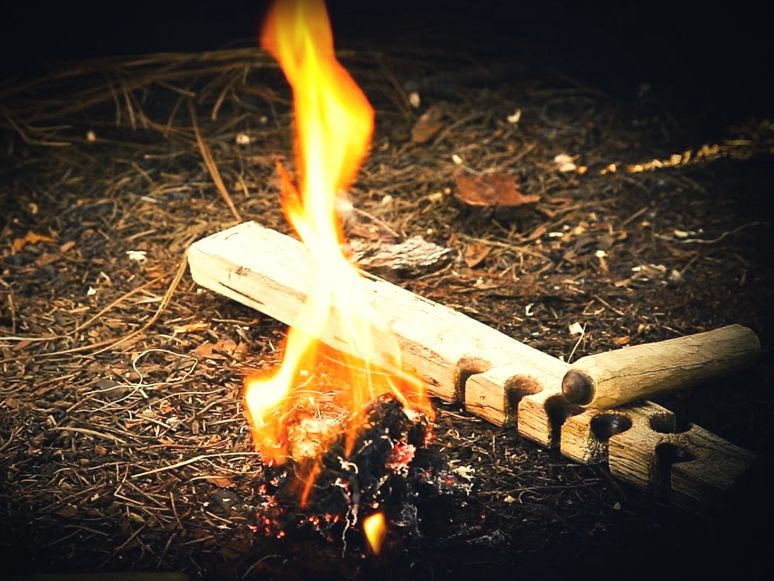
How to do it:
- As in the previous technique, make a hollow in the base wood, where a part of the tinder will be placed.
- Position the drill in the hollow and start rubbing, moving the bow horizontally.
- The technique produces a much faster and more intense friction, without hurting or tiring the hands as much.
Technique 4: fire with stones
This method also fills the popular imagination as the most primitive way to produce fire, used by Neanderthals.
In it, once again, you will need dry vegetable straw for your tinder. It's also possible to use a small piece of cloth and a machete.
Select two stones to form the friction elements. They should not be too heavy or dense, so that the striking motion is possible. The popularly called "fire stones" are common, dry, smooth pebbles, easy to find in various biomes.
How to do it:
- It's possible to create a spark by striking the two stones together, a more difficult method, or by striking a machete against the stone;
- In this technique, the crucial point is the transfer of the spark to the tinder, which will be distant from the friction point due to the striking movements. Use very dry tinder and try to bring it as close as possible;
- It should be noted that this tactic will require a lot of strength. Some people use fabric fixed with their fingers between the stones to try to speed up the process.
Technique 5: fire using lenses
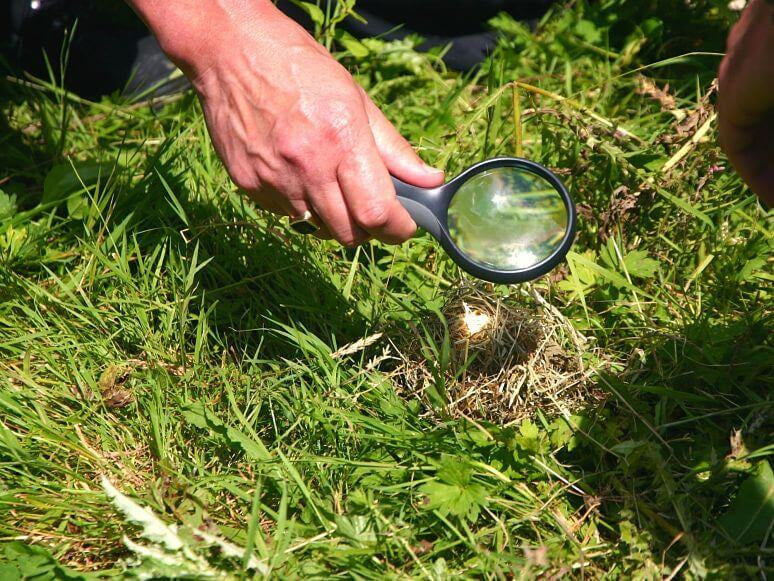
You've probably heard of this technique and even tried to do it as a child. It consists of using sunlight reflected and concentrated by a lens. You can use either a magnifying glass or glasses lenses, if someone in the group uses them. Remember that the sun must be high, with full intensity and heat. This means that this technique can only be used on very clear days.
How to do it:
- Tilt the lens towards the sun until it creates a circle of light on the dry vegetable straw.
- You will need to test different angles until you find the most concentrated light beam possible.
- Then it's just a matter of patience and feeding your flame.
Technique 6: using a pocket knife or knife and a fire steel
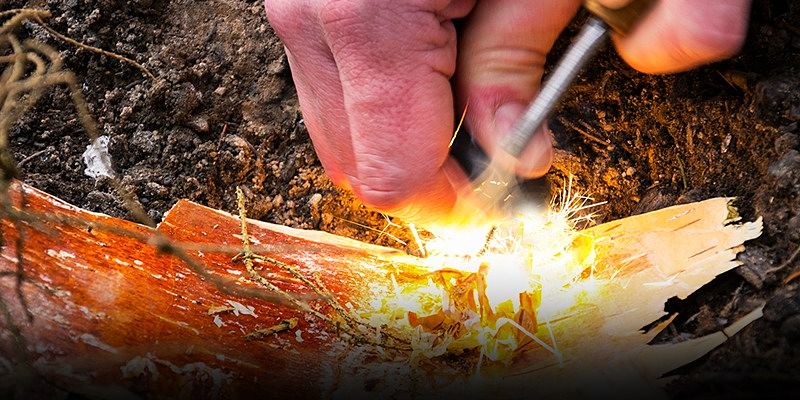
Finally, we have a semi-primitive technique, as we will be dealing with tools that need to be taken to the campsite.
A fire steel is an instrument made of flint (a sedimentary rock, made from cryptocrystalline quartz, a hard material of high density), which contains magnesium, that is, a specific item for making fire.
The great advantage of having such equipment is that if it gets wet, you just need to dry it with a cloth or even on your clothes. Having a fire steel in your wilderness survival kit is always a great recommendation.
How to do it:
- Have a good pocket knife or a camping knife, separate the dry vegetable straw and, with the fire steel and your pocket knife or knife in hand, make a movement as if you were sharpening the tool's blade;
- This will result in many sparks falling on the dry straw and starting the fire. Blow little by little to increase the embers and place larger dry sticks on top;
- The fire will spread gradually.
So, did you like the ideas for making fire primitively? Remember: knowledge without practice doesn't prepare you. It's necessary to practice before going out and consolidate your skills!
Tips for making a campfire safely
Another valuable tip for making fire at a campsite in the wilderness is to choose the location where you will light the fire very carefully. Remember to remove anything flammable nearby. Ideally, you should clean the spot where you will make the campfire.
Another issue to pay attention to is the location of your tent in relation to the fire. Tents are usually made of synthetic materials that are highly flammable.
Most adventurers light a campfire at night, when it's often cold, and also to cook food for the group.
That's why it's important to be careful: everyone will be tired and can easily fall asleep once they settle into their tents. The embers take a long time to extinguish completely, so check if there's anything that could catch fire near them.
Did you like our tips? We hope that now you are more informed and prepared to face your next adventure. Questions or suggestions? Tell us everything in the comments. We respond to all!
Find more information about camping, bushcraft, and survivalism here on the Cutelaria Cimo blog – and remember, we update weekly.
Aproveite e compre junto
Postagens recentes

 17 de June de 2026
Slip Joint Lock: tradição e simplicidade em uso | CIMO
O slip joint lock é um dos mecanismos mais tradicionais da cutelaria, valorizado...

 04 de June de 2026
Cutelaria CIMO participa da IWA OutdoorClassics 2026
CIMO reforçou presença internacional na IWA OutdoorClassics 2026, na Alemanha A Cutelaria CIMO...

 27 de May de 2026
What is cutlery? Get to know the creation of blades!
Did you know that cutlery is one of humanity's oldest ancient techniques? The...