

How to make your own sushi with tips from CIMO Cutlery


Many people are curious about how to make sushi. After all, it's a dish full of ancient techniques and traditions, which impress with their complex flavors and always leave a strong impression on everyone who tries it for the first time. Have you ever thought about preparing your own sushi? We guarantee it's a fun dish full of interesting techniques to learn.
What exactly is sushi?

Sushi (酸し) means something like “sour taste.” Although today it has a more umami flavor, the idea of sourness comes from its origins. We know that rice is a vital delicacy for Japan, and in ancient times, fish was salted and preserved raw inside rice, which was then packed and later discarded when preparing the fish.
This method of preservation in rice released lactic acid, which gave it that distinctive flavor. Over time, the rice was no longer discarded and was consumed with the fish. The first type of sushi, which is still very popular today, is nigirizushi, which consisted of a rice ball with a slice of fish on top.
Today, the whole world loves and admires sushi, and many already prepare their own varieties. We Brazilians are masters of this art! But if you want to know how to make sushi in a practical and traditional way, we'll give you some interesting tips.
What are the types of sushi?

Believe it or not, there are many ways to make this delicacy that seems (but only seems) simple. In addition to meats like salmon, tuna, and octopus, it's very common to use ebi and kani (shrimp and crab meat). And, of course, vegetables, especially carrots, Japanese cucumber, and shiitake, a very popular edible mushroom. Other popular ingredients are tofu, a type of soy cheese, egg, fish roe, and sesame seeds for crunch, and, of course, nori, made from seaweed, which wraps all the ingredients!
Hossomaki
Hossomaki is the most popular type in Japanese lunchboxes, bentos, and they are also very popular here. Basically, any ingredient rolled with nori and rice is usually called hossomaki.
Inarizushi
With a very complex taste, inarizushi is prepared with age, deep-fried tofu pockets filled with rice, which gets an extra pinch of seasoning and pickled ginger pieces.
Nigiri
Nigiri is eaten in different ways. It's a rice ball that can be filled with salmon or tuna, or topped with a slice of salmon. In daily life, it's also often eaten without any filling or topping, just rolled with nori seaweed, and is very popular in children's lunchboxes.
Gunkan
This type of sushi is smaller and carries its filling on top, tightly wrapped. It is usually served as an appetizer.
How to make sushi – step by step
To start preparing your sushi with tradition, it's best to start with the knife most used by Eastern chefs, the famous Santoku knife, which is multifunctional in Japanese cuisine.
Another great friend when preparing sushi is having a small bamboo mat for rolling, but if you don't have one, that's fine, a clean, damp kitchen towel also works.
How to cut salmon
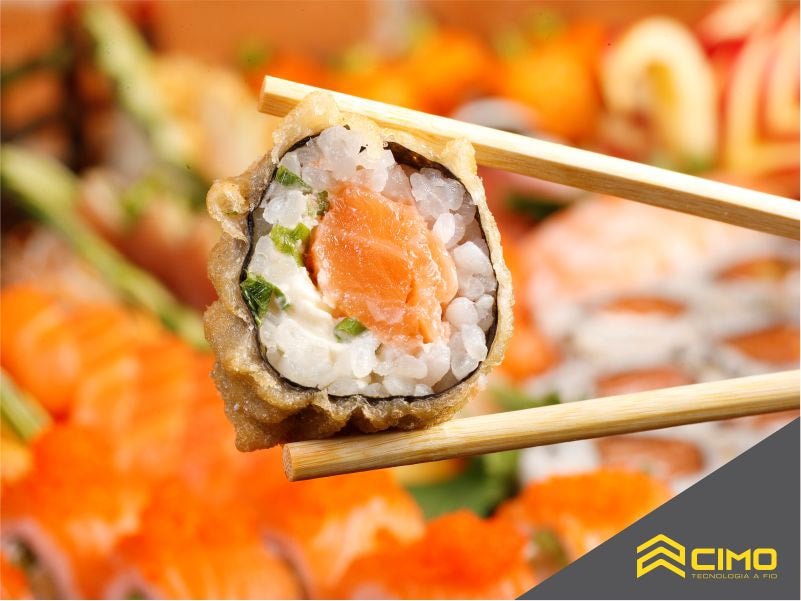
Salmon is a very delicate and extremely flavorful fish. The most important thing is to choose a piece with vibrant tones, neither too orange nor too pale or dark. To handle salmon, it's important to have very cold hands.
If you bought a whole salmon and want to understand how to cut salmon to separate the fillets, the first step is to use your Santoku knife to cut the salmon in half. Remove the spine by cutting with the knife at a 90-degree angle. It's okay to remove a larger piece; later you can scrape all the meat with a spoon and make a gunkan.
With tweezers, remove any remaining bones from the fillet, pulling them in the direction they grow. Pay close attention at this point, and if you want to avoid the strong taste of the fibers, you can cut this part closer to the spine and use it for frying.
To remove the skin, you start from the tail, passing the knife very close. Once you find the right cutting point, it will be very easy to slide the knife. Keep it very flat during the cut and make light back-and-forth movements. Fried salmon skin is delicious and you will certainly want to prepare it to accompany your sushi.
Continue with the same smooth, sliding motion, holding firmly between the handle and the blade's tang if you want to prepare small strips for nigiri. If you want to prepare salmon in cubes, the cut needs to be made with the knife upright, passing it against the grain of the fibers, and then dicing it into cubes, always with a light, back-and-forth sliding motion.
How to make sushi rice

And here comes the great hero of sushi! Preparing sushi rice is something special. Choose a good oriental rice and wash it several times. They say the more it's washed, the more flavorful it becomes.
Remember how we talked earlier about that distinctive, sour taste that gave sushi its name? To reproduce that flavor, you use sake, which is basically fermented rice liquid, a type of rice liquor. But for cooking, the ideal type is mirin, which is sweeter and perfect for culinary use.
In addition to sake, a pinch of salt and another of sugar guarantee that peculiar umami tone of Japanese cuisine.
The best way to make sushi rice is to use two parts water to one part rice. Add sake, salt, and sugar, but without overdoing it. You can reduce the water slightly because of the sake, but you'll find the right consistency as it cooks.
Oriental rice is very sticky, so you'll need to keep your hands moistened when working with it. Dampen your fingertips and make small balls or strips. With the nori laid out on the mat, spread the rice, pressing the balls until they are easy to roll. Then simply add your favorite filling in the middle and roll it up with the mat, very slowly, back and forth, applying good pressure. After that, just cut the rolls. Use tongs to avoid crushing or tearing the nori.
There are several accompaniments for your sushi; shoyu is the most popular. Wasabi is another incredible accompaniment for sushi, with a very strong root flavor (so be careful not to overdo it!).
You can create various ideas with these two techniques: rolling vegetables cut into small cubes, adding sesame seeds between the nori and the rice for extra flavor, using fried salmon strips to hold salmon over nigiri... This is your moment to become a chef!
If you enjoyed this post and created your own sushi ideas, share them with us in the comments and feel free to follow CIMO to learn many more tips on cutlery, barbecue, and sports!
Postagens recentes

 17 de June de 2026
Slip Joint Lock: tradição e simplicidade em uso | CIMO
O slip joint lock é um dos mecanismos mais tradicionais da cutelaria, valorizado...

 04 de June de 2026
Cutelaria CIMO participa da IWA OutdoorClassics 2026
CIMO reforçou presença internacional na IWA OutdoorClassics 2026, na Alemanha A Cutelaria CIMO...

 27 de May de 2026
What is cutlery? Get to know the creation of blades!
Did you know that cutlery is one of humanity's oldest ancient techniques? The...