

Dagger: a knife full of meanings, beauty, and history


A dagger is a very particular type of knife. It can refer to a group of small swords with two identical edges, a sharp point, and highly tempered blades. Throughout its long history, it has served a variety of functions in many different cultures, always leaving an important mark, and today they are items of great added value and significance.
If you enjoy the cutlery lifestyle and want to learn more about this traditional and well-known model, follow the content prepared by the Cutelaria CIMO blog and learn everything about daggers, check it out:
The history of the dagger knife

The use of knives is as old as human history. Blades have always been used as multi-functional tools, from hunting to eating. In technical terms, a dagger can be classified both as a knife (with a ground edge) and as a stiletto, with a piercing function.
The historical importance of daggers is so great that it has attracted the attention of cutlery enthusiasts, historians, and specialists, such as Cutelaria CIMO. An interesting fact: from ancient times, such as Ancient Egypt, daggers have been found in the tombs of pharaohs and other important people.
In the Roman Empire, a symbolic episode involving daggers was the assassination of Julius Caesar, the emperor was betrayed and stabbed multiple times. From then on, the dagger acquired a bad connotation of betrayal and assassination – which does not correspond to the beauty and functionality of the instrument.
There are several types of daggers, with different meanings in the history of peoples. Want to know more? Check out the list we prepared:
The medieval dagger – different meanings
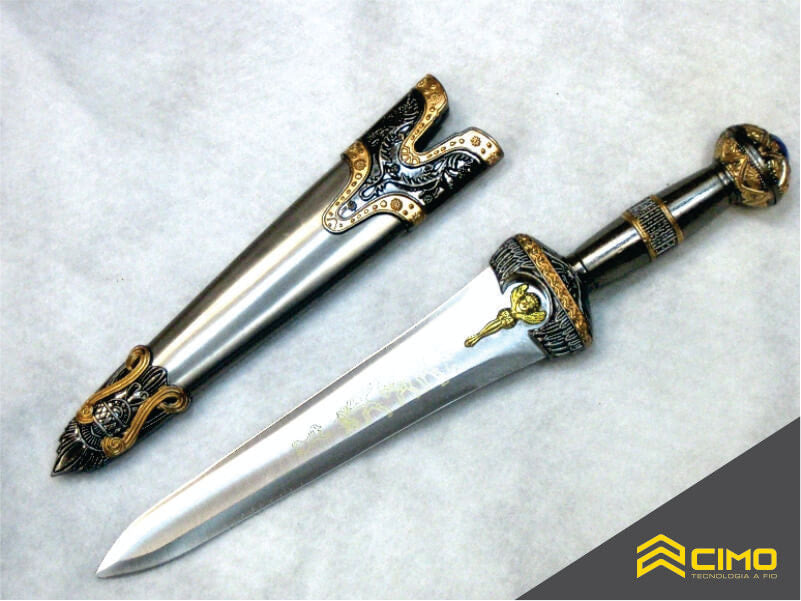
The medieval dagger was produced in different regions: to the north, the Scots had a strong affinity for it, as it was a great companion for hunting, for close combat, eating, and general survival in the wilderness.
However, in France, and the Iberian and Italian regions, medieval daggers were not so well-regarded, being treated as items of foul play and cowardice. Over time, other types of dagger knives were produced, without sharp edges, such as stilettos, which later became important sports items for sword fighting and fencing.
During this era, wielding a dagger as a kind of status symbol was so common, and the culture of cutlery was so popular that daggers were even used at the table to clean teeth. The Renaissance produced some of the best-known knife models – even to this day!
In shamanic cultures and among native peoples of America, daggers had a very strong ritual function, especially related to human sacrifice, and were therefore customized with feathers, jewels, and precious metals.
The gypsy dagger

For the Roma people, the dagger has such a special meaning that it is one of the signs of their zodiac. Every young Roma, upon entering adolescence, received their own dagger, which they considered a great companion, aiding in survival, for their crafts, and also for fighting, when necessary.
The Gypsy dagger is a very popular and beloved item, especially by collectors of sharp objects; its style is unique among cutlery items.
The dagger in modernity

Military forces have always widely used the dagger as a symbol, especially air forces. However, it is the members of infantry forces in general who have always had an intimate relationship with their daggers, with which they often engaged in close combat.
Dagger knives have an enormous variety and are a delight for many collectors, still being very versatile models for camping and fishing sports activities, as well as for survivalism.
Meanings of the dagger – discover the main ones!

Throughout history, the dagger has had different meanings, as you already know. At times, it was a royal piece; at others, a religious artifact full of powers, or else, a piece for survival and daily use. Not to mention its association with sports and even as a weapon of war!
Because it is associated with sacrifice in some cultures, it is directly related to death, but also to sacrifice for an ideal. The Gypsy dagger highly symbolizes independence and shrewdness, self-realization, and also strokes of luck, which is why we often see dagger tattoos alongside dice and cards, for example.
During the post-medieval era, the dagger had a strong symbolism related to marginality, betrayal, and deception. Today, in addition to being a great piece in a cutlery kit, they also adorn the skin in the form of tattoos with various meanings.
Did you like the topic? Visit Cutelaria CIMO and check out all the available knife models!
See you there!
Postagens recentes

 17 de June de 2026
Slip Joint Lock: tradição e simplicidade em uso | CIMO
O slip joint lock é um dos mecanismos mais tradicionais da cutelaria, valorizado...

 04 de June de 2026
Cutelaria CIMO participa da IWA OutdoorClassics 2026
CIMO reforçou presença internacional na IWA OutdoorClassics 2026, na Alemanha A Cutelaria CIMO...

 27 de May de 2026
What is cutlery? Get to know the creation of blades!
Did you know that cutlery is one of humanity's oldest ancient techniques? The...